Here is an update on our animals in winter project. We have spent the last two weeks in phase two, the investigation phase and it has gone well. Each day we have used books and the classroom computers to look up questions from our initial web and many spontaneous questions. Beginning the project, I felt the primary goal was to encourage curiosity and inquiry and not so much retain some of the factual information about hibernation and migration but I found myself really wanting children to internalize some of the factual knowledge. With some trial and error each day, it seemed that they internalized the information most from creative movement. Needless to say we spent time each day stomping and climbing into dens like bears, waddling and caring for our young like penguins, and burrowing into the mud to hibernate like frogs.
To document the knowledge we were acquiring we created a mural, which I will have to photograph and put on the blog), many plays, and the dioramas below accompanied by their own voices to tell the story. We were finishing the storytelling part of this art project on the last day of school before the break so it's definitely rushed.
For the diorama project children first chose an animal to sculpt with clay and wire. We looked at images of the animal and each child was able to tell about how their animal lived in the winter. On the second day, children worked in pairs to create a habitat for the two animals. After the partners were all done, I sat down with them and asked them to tell me a story about their animals.
I do wish we had one more day to add more to the stories, perhaps even adding dialogue which we have been talking about, and practice telling the stories through a microphone.
Here are two dioramas and stories, one by A and V the other by H and C. Enjoy!
Thursday, December 23, 2010


Friday, December 17, 2010
It was a lucky coincidence that our class is showing a good deal of interest in storytelling and we happen to get the opportunity to watch a great short play at Central Park Zoo. The kids though it was hilarious and it inspired another great day of storytelling in the classroom.
Mrs. Lee worked with children in dramatic play again today. Now that they are familiar with the story and acting it out they needed less support from Mrs. Lee. They took turns being different characters and this time they added a director to the lineup. I wish I could post the video on the blog but all of the children's faces are obviously evident, it will have to suffice that it was wonderful and the kids so enjoy watching themselves as actors on the classroom computer.
Mrs. Lee invited the group to come up with their own story to act out. First they held a vote to see if anyone wanted to continue working on The Three Snow Bears or begin a new story. The vote was 1 to 4, in favor of a new story and so it began...
The Bear Story From a Long Time
From a long time ago there is a bear and he makes a friend, it is a penguin. The penguin is in Antarctica. And then there was a big cave. The bear came out from the cave. Then he goes to wash his teeth. And some penguins got killed, so the bear started to protect them and he leads them to the cave. Every penguin is safe in the cave. There is a penguin walks to his friend the bear and then they just be friends together. It was fun. Then they left because they want to go home.
Wednesday, December 15, 2010
put on your investigating hat
As we have become fully invested investigators this week...I've realized how tough it is to not transfer information to the students but rather let them discover information on their own (and in their own time). As we have been seeking the answers to our questions, like: "what animals sleep through the winter?" I have realized how tough the process truly is. More than I ever have before I am allowing children to seek the answers to these tough questions, and they really are tough questions. The concept of hibernation is difficult to contextualize in a classroom setting...it has been a definite learning process for me.
This week we began by coming up with ideas for how we could find the answers to our questions. The children came up with excellent options, saying "we can go outside and check," "go to the Queens Zoo," and "use the computer." I added books to the list. This week we have been using books and the computer each day in the research center to learn more about animals that hibernate. I have found some excellent video footage on the National Geographic Kids Website and Animal Planet, here are the links so you can watch at home with your child - use this as a great chance to discuss what they already know!
http://kids.nationalgeographic.com/kids/animals/creaturefeature/polar-bear/
http://animal.discovery.com/videos/natural-world-bear-hibernation.html
Also, Brain Pop Jr. offers a free one week trial and has some wonderful videos and activities to explain hibernation, migration, and much more. I would definitely recommend giving it a try and watching it with your child. Here is the address,
http://www.brainpopjr.com/
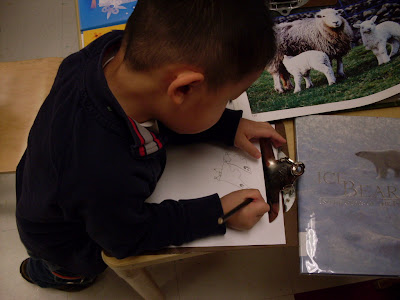
We are using nonfiction and fiction books to learn more about where animals live and how they survive in the winter. Sometimes we use paper and pencil to sketch the animals we see.

We are created a large mural to represent what we are learning. We began by looking through our big picture book of animals, noticing that some animals live where there is a lot of ice and others like where grass and trees dominate. We spoke about these different habitats as the Arctic and the forest. Children used the photographic picture book to paint half of the mural as the Arctic and half as a forest.


The next day we spent time thinking about the animals that live in a forest and that hibernate. K and H made bears, A made a bat, S made a turtle, and A made a frog. Their mixed media collage animals will be added the mural. Next we'll create Arctic animals, and add animals that migrate. The mural will grow over the weeks of our investigation and function as a representation of our learning. In the end, I'm thinking we can write a shared story or explanation of the mural.

There has been interest in storytelling in the dramatic play center, it started with the introduction of our shadow puppets but puppetry and storytelling are tough and interest began to wane. Mrs. Lee and I focused on reigniting the interest by providing a good deal of support (at least to begin with) and slowly we will provide less support in hopes that the children will take charge of the show. It has been so fun to watch the excitement of children working on using different voices for characters, and telling a story together. This week we have been using The Three Snow Bears by Jan Brett. As we grow more confident as storytellers and actors perhaps we'll write our own story to perform!


This week we began by coming up with ideas for how we could find the answers to our questions. The children came up with excellent options, saying "we can go outside and check," "go to the Queens Zoo," and "use the computer." I added books to the list. This week we have been using books and the computer each day in the research center to learn more about animals that hibernate. I have found some excellent video footage on the National Geographic Kids Website and Animal Planet, here are the links so you can watch at home with your child - use this as a great chance to discuss what they already know!
http://kids.nationalgeographic.com/kids/animals/creaturefeature/polar-bear/
http://animal.discovery.com/videos/natural-world-bear-hibernation.html
Also, Brain Pop Jr. offers a free one week trial and has some wonderful videos and activities to explain hibernation, migration, and much more. I would definitely recommend giving it a try and watching it with your child. Here is the address,
http://www.brainpopjr.com/
We are using nonfiction and fiction books to learn more about where animals live and how they survive in the winter. Sometimes we use paper and pencil to sketch the animals we see.


We are created a large mural to represent what we are learning. We began by looking through our big picture book of animals, noticing that some animals live where there is a lot of ice and others like where grass and trees dominate. We spoke about these different habitats as the Arctic and the forest. Children used the photographic picture book to paint half of the mural as the Arctic and half as a forest.


The next day we spent time thinking about the animals that live in a forest and that hibernate. K and H made bears, A made a bat, S made a turtle, and A made a frog. Their mixed media collage animals will be added the mural. Next we'll create Arctic animals, and add animals that migrate. The mural will grow over the weeks of our investigation and function as a representation of our learning. In the end, I'm thinking we can write a shared story or explanation of the mural.

There has been interest in storytelling in the dramatic play center, it started with the introduction of our shadow puppets but puppetry and storytelling are tough and interest began to wane. Mrs. Lee and I focused on reigniting the interest by providing a good deal of support (at least to begin with) and slowly we will provide less support in hopes that the children will take charge of the show. It has been so fun to watch the excitement of children working on using different voices for characters, and telling a story together. This week we have been using The Three Snow Bears by Jan Brett. As we grow more confident as storytellers and actors perhaps we'll write our own story to perform!


Friday, December 10, 2010
Moving to Phase II...that sounds so serious
Phase I
Continuing to build our collective knowledge about animals.
 We explored the texture of fabric pieces and collage materials to make animals. Everyone thought about how their animal stayed warm in the winter.

It was pretty unanimous that animals must sleep to keep warm, and...
 wear clothes.

I love how intense this moment seems.

can you guess which one is the cookie for the animals to eat.
Phase II
Forming our questions (I forgot to take a photo pf our web) and investigating our questions.

Ms. Priscilla, an animal educator from Queens Zoo came to our school to share some hands-on animal artifacts and information with us.

K is feeling blubber that Ms. Priscilla brought in. We also touched and explored animal fur, hair, skin, and feathers. Pretty neat.

After the research group spent some time on the internet with me and Mrs. Lee looking up the answers to our questions: "Do (insert animal here) hibernate?" Calvin took the information he recorded on a Yes/No chart and added it to our web.

Continuing to build our collective knowledge about animals.
 We explored the texture of fabric pieces and collage materials to make animals. Everyone thought about how their animal stayed warm in the winter.
It was pretty unanimous that animals must sleep to keep warm, and...
 wear clothes.
I love how intense this moment seems.

can you guess which one is the cookie for the animals to eat.
Phase II
Forming our questions (I forgot to take a photo pf our web) and investigating our questions.

Ms. Priscilla, an animal educator from Queens Zoo came to our school to share some hands-on animal artifacts and information with us.

K is feeling blubber that Ms. Priscilla brought in. We also touched and explored animal fur, hair, skin, and feathers. Pretty neat.

After the research group spent some time on the internet with me and Mrs. Lee looking up the answers to our questions: "Do (insert animal here) hibernate?" Calvin took the information he recorded on a Yes/No chart and added it to our web.

Saturday, December 4, 2010
A Reggio Inspired Public
I was so grateful to have the opportunity to visit P.S. 69 in the Bronx this week. As I work to incorporate Reggio philosophy on my own, P.S. 69 is probably the only public school in nyc that has an administration incorporating Reggio philosophy in pre-k through first grade. It was refreshing to see the aesthetic elements of Reggio in a public setting. It was helpful to see that we are on the right track in our classroom and it was motivating to hear of the things we can think of implementing too (like a light table, fingers crossed). Here are a few photos from the pre-k classroom I visited. So beautiful.


building shared knowledge
This week was all about pooling our shared knowledge and gaining shared experiences having to do with animals and how they adapt to the cold. I reread the project planning guide daily to insure I was doing what I was supposed to do in phase I...I guess I'm still a bit hung up on making sure we do it right. During the week we seemed pulled at times in two directions, those being experimenting with ice and thinking about animals. I think they complimented each other, at least I hope so.
Here are just a few images of the shadow puppets we made on Friday. Mrs. Lee made a great bear and bird shadow puppet which children started with but then quickly moved on to making there own shado puppets. They did a fantastic job. I think this will continue throughout the next week or longer if the interest level remains.


The inspiration for our bird came from this fabulous Site, The Shadow Puppet Workshop.
http://www.shadowpuppetworkshop.com/photos.html
Here are just a few images of the shadow puppets we made on Friday. Mrs. Lee made a great bear and bird shadow puppet which children started with but then quickly moved on to making there own shado puppets. They did a fantastic job. I think this will continue throughout the next week or longer if the interest level remains.


The inspiration for our bird came from this fabulous Site, The Shadow Puppet Workshop.
http://www.shadowpuppetworkshop.com/photos.html
Wednesday, December 1, 2010
our common experience
I'm using the "Project Planning Journal" from the Young Investigators book as a tool for our animal adaptation project. We are in Phase I of the project, which is a time to "establish a common ground among the children by pooling the information, ideas, and experiences they already have on a topic. Build a shared perspective. During the preliminary discussions, the teacher encourages talking about a topic, playing, and depicting current understanding in many ways (Katz & Chard, 1989, p.82)."
With this in mind I am adding provocations to the learning centers in the classroom to encourage play to build on our understanding of animals.
C and A worked together at the water table melting and chipping apart a block of ice with animals frozen inside.

C: "Let's work on this one. We are chipping it."
A: Look, I got three bears now."
Me: "What is ice?"
A: "Ice is cold."
C: "Ice is water, ice is made of water."

A and K added animals, lincoln logs, and "snow" cotton balls to the sand table. They buried the animals in houses to protect them.

At one point they told me they needed something like a roof to keep the animals safe from rain and snow. I gave them two long pieces of cardboard and they fashioned a roof for themselves.


P and others add animals, cotton ball "snow" and signs to their zoo.


As we continue to work on establishing a common ground the next steps will be to extend their interest and build a common vocabulary.
I will be observing at a Reggio inspired public school tomorrow, P.S. 69 in the Bronx so I'll give the next update on Thursday.
With this in mind I am adding provocations to the learning centers in the classroom to encourage play to build on our understanding of animals.
C and A worked together at the water table melting and chipping apart a block of ice with animals frozen inside.

C: "Let's work on this one. We are chipping it."
A: Look, I got three bears now."
Me: "What is ice?"
A: "Ice is cold."
C: "Ice is water, ice is made of water."

A and K added animals, lincoln logs, and "snow" cotton balls to the sand table. They buried the animals in houses to protect them.

At one point they told me they needed something like a roof to keep the animals safe from rain and snow. I gave them two long pieces of cardboard and they fashioned a roof for themselves.


P and others add animals, cotton ball "snow" and signs to their zoo.


As we continue to work on establishing a common ground the next steps will be to extend their interest and build a common vocabulary.
I will be observing at a Reggio inspired public school tomorrow, P.S. 69 in the Bronx so I'll give the next update on Thursday.
Subscribe to:
Posts (Atom)
LinkWithin
