Monday, October 31, 2011

puddles puddles everywhere

We have taken a step back from projects, first allowing our class to develop a culture of thinking and thinking language. We do this by focusing on building a 'thinking' foundation, posing questions, modeling thinking and wondering aloud, and providing opportunities for engagement. Yet, even with project work taking a backseat for the moment - the visible interest in water and puddles is too evident to ignore. In an effort to make the children's thought process about puddles and water visible we created a See/Think/Wonder chart. This is a thinking routine, you can read more about thinking routines in this paper by Project Zero and you can find many more great resources about thinking routines here at Project Zero's Visible Thinking Site.

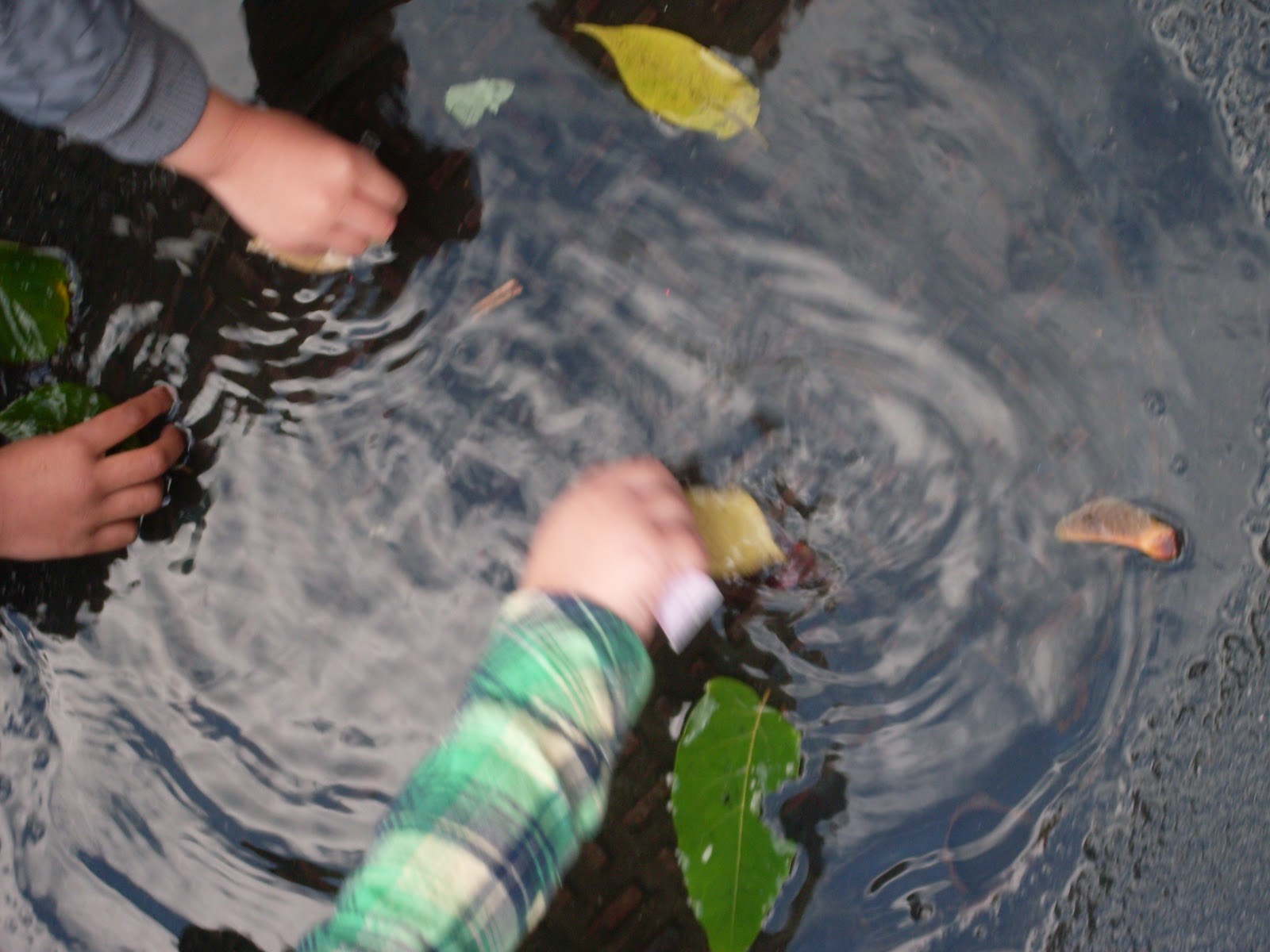
First we observed a photo of children exploring a puddle the day before. Then...


Children respond to what they see: water, stuff in the water, it's a puddle, the water is shaking, and we can touch the water

Children respond to what they think they know about puddles: that puddles are very big or very small, puddles look like circle, and puddles are watery but you can jump in them.

And children wonder: If we could get bottles to measure water.
 
As I write this I realize I have  forgotten to pose an important question to the children. What is interesting about puddles? Looking at the images below I can make assumptions - why I think puddles are of interest to children. If you look at the images below, what would you say provokes interest? This is an important step as an educator, forming our own theories and then revisiting those theories...


Friday, October 28, 2011

Learning Stories

As a public school teacher assessment is often on my mind. There is the personal motivation to best know your students and how to best nurture each child's development. There are also school-wide and state mandated standards and assessment expectations to be addressed. In the last four years of teaching pre-k I have tried to find a balance between authentic assessment and being held very accountable to my own administration and state (when quality review time roles around). In my research I read about learning stories and felt strongly that this could be a valuable assessment tool. the narrative format is strengths-based and a connection can be made to state or Common Core standards. 

I was lucky to find wonderful resources from fellow education bloggers, like over at The Living Classroom, which has a downloadable template, which is helpful to understand format. Below is my first try at a learning story. This one is a bit long as it involves three children but others are shorter. This is now a piece of the portfolio assessment system I have in place and I think it brings me further toward the goal of accountable yet very authentic assessment.

A Learning Story

I found E and G referring to the book Block City while building together in the block center. They were replicating the structure from the book with purposeful focus, looking back to the book often to check their progress. Later E said, "Now I’m going to build this,” turning to a page in How to Build a House. Soon their independent replicas began to connect… 
the structures become something much bigger once connected. E,E, and G shared the space and materials to build. The structure grew, sprawling across most of the available floor space. They allowed each other to incorporate blocks as each pleased, a true shared creation and experience.


After some time, I showed the group the chalk board and chalk available in the center and invited them to continue drawing ideas for their structure, “like a plan or blueprint.” They eagerly grabbed chalk and drew on the space together. E said they were building “My New York.”


After nearly half an hour on the second day of building E started, at first, to knock over a few small blocks intentionally. As G and E said nothing he continued. He began slowly and then soon swam with his whole body in the sea of blocks. G participated a little – while E watched. Later when E and E saw photos of the experience, E said he didn’t want everybody to knock it down.


What It Means 

Less than a month into the school year, the block center is still a place of new exploration. The three boys in block center, over the course of the two days, showed their desire to collaborate with their peers. The willingness of each child to let others impose their own, individual ideas, throughout the building process gave great insight into the ability of each child to share, take turns, collaborate and listen to others.  

The instinct of each boy to look to books as a resource for information highlights their familiarity with books and leads me to wonder how their families use books at home – does mom or dad use books to find information? It is also possible that they followed the lead of their peers. As E was the first to sit and read the books in the center, that could have motivated E and G to use books as well as a resource.  

The children also showed their dexterity, hand-eye coordination, and over-all well-developed fine motor skills in building such a complex structure.

Opportunities and Possibilities 

The maturity and complexity of their building process could mean a keen interest in construction. These boys might be interested in observing the construction of the new apartment building across the street. Anny and I should plan to stop in front of this building on the next walking trip and speak with E,E, and G about the building to see if there is interest. 

The interest and authentic use of text in the block center makes it clear that we need to monitor how the books are being used and ensure than we are rotating books to add new inspiration. We could ask the children if they would like to make their own block book as well, to keep in the block center. This would be a purposeful literacy experience and instill a sense of pride and ownership, from creating a “useable” book.
             
After the experience was complete and E shared that he did not want the blocks knocked down I realized that I should have prompted E to check with his co-collaborators first before razing “My New York.” This reinforces using language to ask questions and express ourselves. This is a reminder for me and Anny as we work to create the culture of our classroom community.


NEW YORK STATE PREKINDERGARTEN LEARNING STANDARDS

Domain: Approaches to Learning
  • Children actively and confidently engage in play as a means of exploration and learning.
  • Children approach tasks, activities and problems with creativity, imagination and/or willingness to try new experiences or activities.
Domain: Social and Emotional Development
  • Children demonstrate pro-social problem solving skills in social interactions.
  • Children develop positive relationships with their peers.
Domain: Communication, Language, and Literacy
Viewing
  • Children demonstrate that they understand what they observe.
Representing
  • Children demonstrate their ability to express their ideas using a variety of media.
Writing
  • Children demonstrate their ability to express their ideas using a variety of media.
Reading
  • Children demonstrate motivation to read.
  • Children demonstrate knowledge and awareness of book/print concepts.
Domain: Cognition and Knowledge of the World (Mathematics)
  • Make sense of problems and persevere in solving the problem.


Tuesday, October 11, 2011

creating the circumstances

I mentioned the idea of 'flow' in this post the other day. These two thought provoking TED talks relate back to this idea of complete engagement. I think both videos address the question of why 'flow' is valuable and necessary in education. To be so completely engaged in an activity means - a child must feel a sense of interest and curiosity, must go through steps of thinking and problem solving, and in the process may be gaining valuable insights about what their passions and strengths are.

My interest in 'flow' stemmed from interest in developing children's critical thinking skills, but Sir Ken Robinson's talk brought into the equation the idea of the human need to understand our inner talents and passion.
Education, in a way, dislocates very many people from their natural talents. And human resources are like natural resources they're often buried deep. You have to looking for them. They're not just lying around on the surface. You have to create the circumstances for them to show themselves...Human communities depend upon a diversity of talent not a singular conception of ability. 

Monday, October 10, 2011

a culture of storytelling

I just registered for this year's Wonderplay conference and am already looking forward to the day, especially having the opportunity to hear Vivian Paley speak.  They shared a wonderful excerpt of Paley's talk from the 2008 conference.

Her work regarding play and storytelling has inspired a culture of storytelling in our classroom. Here are a few stories that have already been written and performed in our classroom. To add a bit of context - each day two storytellers tell me a story, which I write down word for word. After they tell their story to me, we look at the number of characters in the story and I invite the storyteller to choose who they wish to be during the performance. They make their choice and then we ask other children in the audience to act the parts of other necessary characters. The performances are an end of the day ritual that we all really enjoy. *I wish I could share images of daily perfomances but it is impossible to do so without showing the faces of the children*
 
I Was Scared 
A wolf was there and it scared me! And they attack me and able to put me in the net. So they put me in the box and they put me in the web. Then I bounce, bounce, bounce on the spider web. And we play together. Then we play painting. And me and wolf, we played painting game and eat orange. Then we eat vegetables and noodles and we share together. Then we eat together. And we look each other and we jump on the trampoline. And we eat watermelon. Then we smiled and we enjoy!  

Ugly Monster Run 
One day three ugly monster and there was a ghost behind her the ugly monster. And he ran away! The ugly monster run away. Then the ghost say “boooo.” And he say “why the ghost scare me? I run away!” The she never see the three ugly monster again.  

All About In Pre-k 
I was too shy and my friend and I went with him and I wasn’t shy. I go with my friend at home and eat and with my mom. I was resting with a mat in the floor for a sleepover with my brother because there’s no space so that’s why I need a mat. When I sleep with my mat I play with my toys over here. And you use it for the swimming pool – it floats.  

My First Fairy Tale 
One day the three little bears went out to go for a walk. Then a naughty girl named Goldilocks that she was very hungry so she look for a bowl to eat some porridge. Then she use the small medium size but it was too cold. Then she tries the baby size one and it was just right. Then when the three little bears came back she wake up and then she ran away to the jungle.

in the 'flow'

I have been reading quite a bit about Mihal Csikszentmihalyi's work on 'flow theory.' A person is in a state of 'flow' when they are completely absorbed in the moment, free from distraction and constraints of time. I became interested in this because it is in these states of engagement where creation and innovation takes place. An artist could not create without being completely absorbed in the process of creating, just as a scientist could not innovate, and an author could not write without these moments. We've all experienced such moments, where we are completely taken over by our curiosity and engage it. This is what life is about, being actively engaged in wondering, tinkering, making, and doing.

From an education perspective this directly relates to student engagement, optimal learning environments, and the pursuit of engaging wonder and letting it take children wherever it may. To read more about the theory, read  here. 

The images below are from a day that we introduced the light table as a space for creating art. the calm focus, deliberate mark making, and engagement were present in the facial expressions and movements of each child. How do we, as educators, encourage moments like these? Does our education system value this type of engagement? Is it even valuable?
 
.


Wednesday, October 5, 2011

what would you do with 1000 popsicle sticks?

Okay, now Wikipedia makes the bold statement that stick bombs have been known to children for ages and all I can wonder is "how did I not know?" Thanks to Gizmodo, I saw this inspiring family-built stick bomb today. The pure joy of creating this impermanent experiment is a lesson in physics, creativity, engineering, self-regulation, and dexterity. Not to mention the lesson of non-attachment, the thrill of this is the impermanence.


This seems like a handy tutorial . Time to start collecting Popsicle sticks!

Saturday, October 1, 2011

assessment remix

What does a teacher do with a four day weekend? Blog...and read the many profoundly inspiring early childhood blogs out there. In my reading, I was keeping an eye open for authentic assessment discussion/reflections/ideas. I came across the idea of learning stories, this Site of examples comes from Tom Drummond. At first the idea seemed a bit overwhelming, so much writing for one small moment! But then I browsed through my own images and came across a two-day block building scenario, involving three children in my class. Without yet consulting the Common Core Standards I know that this experience addresses several domains. I don't want to begin something as serious as this without researching it more but it seems a wonderful was to ensure assessment is meaningful and strength based. I will be buying Margaret Carr's book today to learn more about learning stories as an assessment tool. I'm curious to hear about other educator's assessment practices, does anyone have experience with using learning stories?

Below are photos of the building process; from using literature to inspire ideas, drawing to plan, building collaboratively, and then giving in to the desire to destroy and swim in a sea of blocks. My hunch is that this addresses every domain. What do you think?


LinkWithin

Related Posts Plugin for WordPress, Blogger...