Showing posts with label project work. Show all posts

Wednesday, January 4, 2017

the joy of the plan

Oh winter vacation. It's amazing to me how time to rest, drink copious amounts of coffee, and play with my son make space for recommitting to work life. With a few days left of the winter holiday I find myself planning and thinking about the joy that Monday will bring when I return to work. Okay, okay, it's true I have an especially enjoyable job as a preschool teacher...maybe this would be less true if I were an...accountant.

Today I will simply share a planning document I use that works particularly well for project-based learning. Next week we will begin a new unit of inquiry, in the spirit of project-based learning. You can read more about this way of teaching and learning here. As we will begin the first phase of our project, the focus will be on exploration, which you can see from the simplicity of the initial plan.

One truth I have come to discover over the years is that I have to create my own planning form. I remember during observational visits to other schools I would be intrigued by the planning documents of fellow educators and during my visit to Reggio Emilia...well I was blown away by their planning sheet (If I remember correctly it was on A3 paper!) I meticulously sketched the forms in my journal and took photos...but you know what...it would never completely work for me. It's a personal business - teaching - and it requires knowing and understanding our own needs, learning styles, and organizational styles.

Don't worry all of those sketches and photos are still stored on my book shelf - and in my brain - but they are now my inspiration. The format I use below has bits and pieces pulled from my learnings and experiences of the past but it is the result of fine-tuning over time. I'm sharing it just in case it might be useful inspiration for someone else.

An important element to note is the inclusion of observations and next steps. This planning document is also my tool for recording student dialogue and notes. This year all three teachers in the classroom will have a hard copy of this form to *hopefully* help us to organize and share our observations and ideas for next steps. I would also like to note that this is the daily planning and observing guide but the bigger picture is mapped out in other ways - and in other spaces. To be shared another day!


Friday, February 3, 2012

the proof's in the pudding but where's the pudding?


Well, my camera is without battery so I must rely on my words (not too many, I promise) and one video to share my sleepy Friday night insights. Thanks to Allie over at bakers and astronauts I read an excellent article about documentation. If you're interested in reading, head over to Allie's blog and sign on to be a part of the ECC dialogue, which is a discussion group she just started. The first article Documentation: A Hard Place to Reach by Janice Kroeger and Terri Cardy prompted me to take a look at my documentation practice - and more precisely what my intention was when documenting. I realized two things - one I often feel a need to share the whole project work (history) to families and the school community by creating panels. This is an important component of documentation but really the most important element (in my opinion) is using documentation to make children's learning visible (to them) and as a tool to deepen play, experiences, theories, and ideas. This is where I was lacking. It's interesting because as much as I value process over product - this is what I was doing - favoring product (a panel) over documentation/traces being used consistently in the classroom (process).

It takes a lot of time to go through photographs, video, and notes each day. Yet this is the heart of documentation - to use it as an active process in moving forward. It is not (simply) an archival process, it is a responsive process in taking next steps and informing curricular decisions.

Time is an issue. Somehow the process of collecting and analyzing needs to be streamlined to make it easier to succeed. With this in mind, Ms. Anny and I (who also read the article) made an effort to make the children's art/ideas/work visible in the classroom. We also focused our efforts on using the documentation to prepare the learning environment - adding provocations, making changes, and really thinking about the materials that would best support the children. It resulted in a pretty amazing week, each day felt like a change in the environment - a mentioning of a previous idea - or a provocation inspired the children which in turn inspired us. It's sounds a bit like a fairy tale I know (especially with no photos to prove it!) but it was an inspirational week.

I'll share images on Monday but to give a bit of context we were immersed in the study of animals. There was a lot of high-interest activity with two rabbits in our room, animal tracks appearing daily (including predators looking for the rabbits), and the need for children to protect the rabbits and solve many problems. Here is one story that emerged after a student set an owl trap - hoping to catch the barn owl...before it caught the rabbit.

Thursday, January 26, 2012

orange feet in the night

Our week...in pictures and (some) rhyme.


Tracks in the snow, tracks in the snow

Where do they go...

and whose tracks are they?

Each child finds their own way to share - through talking, writing, drawing, and more.

Animals visited our room during the night...

leaving footprints: red, purple, brown, and blue.

Tracking guides and books provide many clues.

So excited some run straight for the books -
before hanging their coats on hooks!

A big idea, a great idea...

to leave food for our animal friends in hopes of their return.

But balancing bowls from the ceiling is tough.
It requires some practice and perseverance to not give up.

Soon bowls of food began going up on the ceiling.

Come on crows, giraffes, and elephants...come to eat food in our room,
there's more than enough.

Friday, January 13, 2012

the dance

Several months ago I read a research article examining the differences between Norway and Finland's education systems. Finland surpasses Norway on the PISA and Norway funded this bit of research, hoping to better understand why their Nordic neighbor surpasses them educationally (at least in regard to the PISA). I apologize that I can not find this article now and the title is escaping me. Much was discovered through the research but what has stayed with me is the value teachers in Finland place on teacher child interaction. The researcher found that teachers provide more immediate, consistent, and meaningful feedback in Finland. This has powerful implications, especially for struggling students. If a student or students are struggling and teacher feedback is limited then the chance for success diminishes.

The topic of interaction and my role as a teacher has been on my mind in recent weeks, especially surrounding the puppet project. This study began months ago as we noticed children radiating pure joy when interacting with finger puppets. As time passed and we all gained experience with storytelling, retelling, and puppet exploration I invited my father to visit the class to help children build a puppet theater of our own.


Children created a blueprint for the theater and luckily my father's design bared a striking resemblance to their plan.


The immediate response was strong, with children wanting to visit the puppet theater often. As we observed children during play we noticed the inherent difficulty in delving deeper into puppetry. Children need to listen to one another, collaborate, and negotiate ideas. These are skills difficult for us all but especially difficult for young children. Ms. Anny and I responded when it seemed children needed assistance before becoming frustrated and we modeled several puppet shows. Then the unimaginable happened. Children were done with puppets, the interest disappeared.

What happened?

Frustration happened.

When working through project-based learning teacher interaction is so vital. Providing a foundation, a reservoir of skills children can tap into later is the goal but in this situation I didn't step in enough to stave off the Great Wall of Frustration.

We could give up.

Sometimes throwing in the towel is the responsive thing to do - however in this situation I feel strongly that the responsive action is to persevere. I chose a small group of 5 children who have shown great interest in puppetry over the last several months. We revisited some of our favorite stories together, talking about the characters and their traits. Then I invited children to create their own character. They drew a small sketch of their character and told a story about their character. Later I enlarged the sketches and surprised the group with larger versions of their characters to paint in creating a final puppet.


We now have five monster characters, some are grumpy and some are nice. In fact one eats dinosaur food. Our next step will be to write a shared story using these characters, perform and record the puppet show. I'm not sure what will come of it. The class may be beyond excited to watch the "movie" on the Smart Board...or the puppet craze may just be finished after this.

It's such a dance - knowing when to stand back and when to guide more directly. Luckily we can always take a step back

Sunday, December 4, 2011

intentional experiences

I mentioned that I would soon write a post to connect the dots - to share what the seemingly random musings about paper and puddles are all about. Well, every experience is meaningful, whether it is connected to something perceived as bigger or not. Every experience is big. However, there is a context that I want to share.

This year two interests have emerged from the children, one being a serious love of water and the other being an equally intense love of puppets. As Ms. Anny and I took these two interests and planned possibilities and provocations, we thought about the skills (potentially) helpful for children. I have been reading Ann Pelo's The Language Art and this quote struck me as such an important reminder.
As children become more comfortable and skillful with these media, they are able to use them to communicate their understandings, emotions, and questions, Their fluency in a range of art "languages," in turn, opens new possibilities for collaboration and dialogue, for taking new perspectives, and for deepening their relationships with each other.
This is our privilege - to support children in knowing the different "languages" available for expressing their ideas, emotions, learning, and questions.
                  
The Language of Clay

As we created anticipatory plans for a puddle and water project we considered how children might represent their learning later in the project. As the playground and manhole covers are central to this - we felt that three-dimensional representation could be important. From this idea we worked backward - determining that observation (and observational drawing) would be an important "language" and would be necessary for any three-dimensional representation to occur. We also felt that experiences with clay would be key.

Do we know if this is where children will take the project? That is a resounding - no - but the language of observational drawing and clay can now be part of their toolbox for communicating and representing. That is our job - to give children the tools. Support them, in learning new skills in using a medium and tools. Then watch what they build.


The Language of Paper

We wanted children to really know the qualities and possibilities of paper and cardboard. These explorations, so intrinsically valuable, will later lead to inviting children to use paper and cardboard to create puppet characters.  We want children to feel confident in their abilities to wield tools and materials - to make meaning with the material.
So, where will it all go? Well, we don't really know. That is the beauty of it all. We will listen, we will observe, we will reflect, and we will value the importance of each experience for what it is - not for what we want it to become.

Monday, October 31, 2011

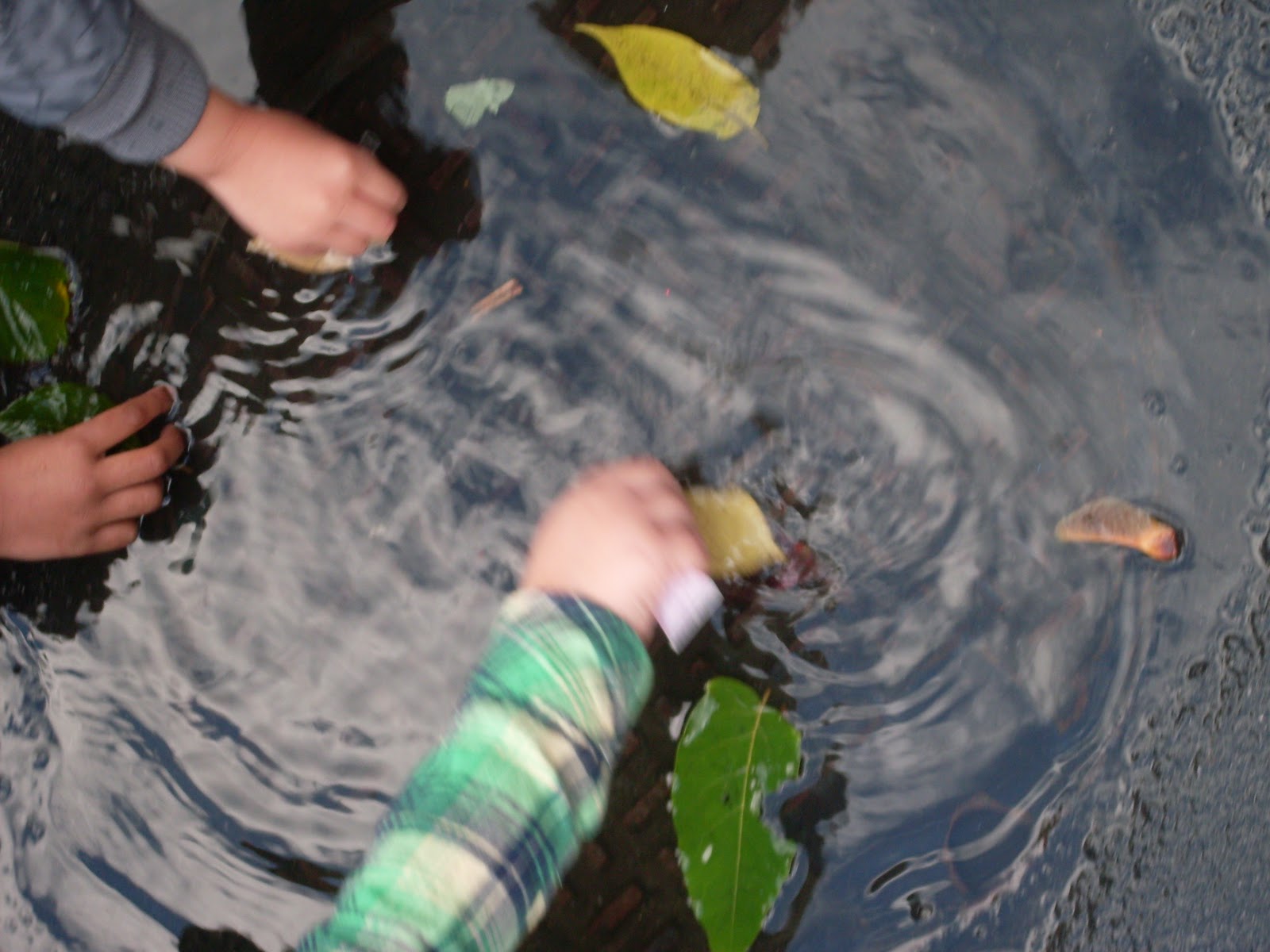
puddles puddles everywhere

We have taken a step back from projects, first allowing our class to develop a culture of thinking and thinking language. We do this by focusing on building a 'thinking' foundation, posing questions, modeling thinking and wondering aloud, and providing opportunities for engagement. Yet, even with project work taking a backseat for the moment - the visible interest in water and puddles is too evident to ignore. In an effort to make the children's thought process about puddles and water visible we created a See/Think/Wonder chart. This is a thinking routine, you can read more about thinking routines in this paper by Project Zero and you can find many more great resources about thinking routines here at Project Zero's Visible Thinking Site.

First we observed a photo of children exploring a puddle the day before. Then...


Children respond to what they see: water, stuff in the water, it's a puddle, the water is shaking, and we can touch the water

Children respond to what they think they know about puddles: that puddles are very big or very small, puddles look like circle, and puddles are watery but you can jump in them.

And children wonder: If we could get bottles to measure water.
 
As I write this I realize I have  forgotten to pose an important question to the children. What is interesting about puddles? Looking at the images below I can make assumptions - why I think puddles are of interest to children. If you look at the images below, what would you say provokes interest? This is an important step as an educator, forming our own theories and then revisiting those theories...


Thursday, September 29, 2011

silent sound theories

We have noticed a great curiosity regarding sound with our group this year. Our first noticing occurred one morning in dramatic play, when one child held the fire fighter hat to her ear and declared that she heard something. We capitalized on this moment, first making seashells available and asking if the sound was similar to that of the hat. Then came instruments, inside and brought outside, and the invitation to build an instrument. But I have been given a big reminder that to move past this exploratory stage, to go deeper in to developing theories about sound and music, the children need a foundation in deeper thinking. I realized this when my questions to children were left floating in space. It's a reminder to model critical thinking. It's a great honor and responsibility we have as early childhood educators to be part of developing the foundation - of harnessing curiosity and helping children develop critical thinking traits. So I am reminded that it is still early in the year and to spend a great deal of time and care in building the foundation...from there we will build to great heights, I am sure. My current reading interest has been all about thinking and making thinking visible to children, there is so much here at Project Zero's "thinking routines" for educators and parents.


Where does the sound come from?

One broken maraca, but the pleasure of the exploration was well worth it.

How does this make music? This question, was not answered verbally but it so clear the provocation led him to look a bit closer. 

Now an expert, he can help others.

beginning to create his own instrument.

Friday, March 25, 2011

color theories continued

As we have been recording many of the conversations and talk surrounding our explorations of color I have been surprised to hear some of the ideas, feelings and theories surrounding color. Here are some photos and bits of conversation from the week. I know that many Reggio schools study color and I'm definitely curious to hear about the direction teachers and children have taken in studying color, so please share!

This first conversation has an interesting conversation about white/light and black/dark. I'm not sure where we will go with this. But the conversation between K and Mrs. Lee is interesting and I think we will pursue this thread of thought.


K: We need a lot of white
Mrs. Lee: Why do you need so much white?
K: So we can make different colors. White is the most beautiful
Mrs. Lee: Why do you think white is the most beautiful?
K: Because white is the most special because there is a lot of light.
Mrs. Lee: So you think white is a light color and helps us see other colors. That’s interesting.
Mrs. Lee: How about black, can we use black to mix and make different colors?
K: No.
Mrs. Lee: No, why not?
K: Because black is not special.
A: black is special. Because black has so many beautiful mixing colors.


On another day, I began to ask children questions to deepen their thinking about colors but as you can see they were more focused exploring and announcing their discoveries. It's important to know when to push and when to sit back and listen. I think I got the hint pretty quickly to be quiet here.


K: Look I made dark blue. First you need yellow and then red and then blue. You need a lot of blue.
V: I mixed yellow and blue.
C: I made three kinds of different green
Ms. Merril: Can you tell me about the three kinds of green?
C: First I made dark green.
P: I made the dark purple, dark purple, dark.
K: I made light orange and dark orange
C: I made four different kind of orange
V: I made four different kind of orange but Kellie how did you make light green?
K: Umm all of the colors
V: You need all of the colors?
V: Okay, got light green
C: I made light green. I made very dark green.
C: I made a rainbow yogurt. You can see colors underneath because I add so much water
Ms. Merril: I see the colors underneath too
C: And it’s rainbow over here


One morning the conversation focused on how many colors we thought there were in the world. The numbers ranged from 6 to 108. That day children explored mixing colors to create as many color variations as they could. We counted 28 when all was said and done. I'm thinking next week I will bring in the BIG Crayola pack so we can read and see all of the color variations and compare with our findings.


and here is a photo of our new light adorned light center! I couldn't resist posting because I love the lights so much, they make the room feel very cozy. Thank you to a local hardware store who donated quite a bit to us as they were closing down the store.

Thursday, March 3, 2011

where we will go nobody can know

The last few days have been really exciting. I anticipated the children's interest in dinosaurs might lead to an interest in reptiles but what has emerged is a real interest in eggs. Their conversations and ideas have been inspiring and we've been luck to have Ms. P with us who has experience with the Reggio philosophy and therefore is a documentation expert. I will try to give some sense of our beginning study here.

Yesterday at morning meeting, I let the children know that we've noticed a great deal of play, art, and talk revolving around dinosaur eggs. I had a balloon with me and I blew it up until we reached a consensus (over the laughter) of what a dinosaur egg may have looked like. Afterward, I prompted them to think of another animal that lays eggs and the idea of a bird came forward. As the conversation continued a few children came up with the idea to build a nest and a tree house on our playground. Six children emerged, being very enthusiastic about this idea of theirs. That small group joined Miss P to draw their plans. Below each plan are their words.


K: My plan is that we can make names of birds in the trees so they know what tree to go to and we put bird food there. These are the nest and these are the houses. Maybe we need paint and we buy wood to make the house. We can find leaves and build a nest. Nest comes from leaves.


Z: This is one leaf. This is a climb. Climb, climb, climb. We can make a house and a bridge.
Ms. P: Why do the birds need a bridge?
Z: Because it’s too tall.


P: That’s a tree house. This is a ladder to climb up the tree. We are going to find bird nest
Ms. P: What can you use to make a nest?
P: Leaves and grass to make a nest. We can go to a zoo and see how a chicken hatches an egg. Then we can take the egg. This is a bird and her egg. She is trying to hatch the egg. She is using her beak to hatch the egg.


C: My plan was there’s two ladders and we can split up in two groups so we can both climb up the ladder and see the bird nest and the house they got eggs.
Ms. M: What materials could we use to build a nest?
C: Some twigs and some yarn, that’s it. Oh and some balloons so he can decorate it!
Ms. M: Have you ever seen a real bird’s nest?
C: Yeah, across the street. I saw it up in that tree, now I don’t.
Ms. M: Where did it go?
C: It went on vacation (referring to the bird)
Ms. M: What happened to the nest? Did the bird take it on vacation?
C: I think the nest broke.

Today, these same children carried forth their plans with such purpose, as you can see below.


Since K showed interest in creating signs for the birds to know which tree to fly to I asked her if she was interested in creating those signs. She was excited to do so and used the fantastic book Bird Songs From Around the World to find images. I gave her a set of post it page tabs and asked her to mark the birds she has seen in our neighborhood or ones that she thinks live in our neighborhood. She paged through the book carefully finding exotic birds that I wish lived in our city.


She used bright colors to write the name of each bird and drew a picture of the bird, so the birds would find the right tree.


Later, Z joined her and they created bird signs together.


Meanwhile, A, P, and C were busy carrying out their plans by constructing a bird house and nest with mostly recycled materials.


Busy hands as you can see.


There was a problem getting the pieces of cardboard to affix to one another using scotch tape, I'm not sure if this was due to the heavy coat of oil pastel on top of the cardboard but it was time to use the big guns...the glue gun! This was the first time we used the glue gun and the boys were very into it.


Tada! P's bird house with a little help from his friends.


and C's bird nest with some contruction help from Ms. P. Each side was cut from cardboard and took a lot of effort to come together as a stable nest.

As I looked around the room today during our working time I was so struck by the juxtaposition of what it looked like as an observer, which was chaos versus what was happening beneath the surface, which was each child completely engaged in the study of eggs in their own (self-directed) way. I watched a documentary last night, The Waldorf Promise and it really made me think about my own education, which was truly unremarkable. I don't feel like I ever had much ownership of it in my early years. It is that unfortunate reality, the reality of the majority, that makes days like this so inspiring and reaffirms that we are moving in the right direction, at least in our class.

LinkWithin

Related Posts Plugin for WordPress, Blogger...