Wednesday, November 30, 2011

lines and circles

I will dedicate a post soon to connecting the dots between the posts on water, puddles, and paper. These posts have been 'snapshots' of larger projects underway in class. For now I will share a few images from a morning of observation. Three of our most avid water explorers (and puddle jumpers) went outside with Ms. Anny to observe the manhole covers on our playground. For months now, these three children have visited these covers each day looking for water, interracting with water on top of the covers, and often dumping water onto the covers on sunny, dry days. I was struck by the reverence of their drawings - you can tell that the children know the manhole covers.


Ms. Anny visited MOMA over the Thanksgiving break and discovered the photographs of Joseph Dankowski. We viewed MOMA's image gallery of his work, dedicated to the surprising beauty of manhole covers. Here are two of his photos...


Tuesday, November 29, 2011

an ode to blocks (from me and the new york times)


Blocks are my favorite. It is my favorite center. I love how children feel so proud and satisfied when they stand back and look at a structure they built. I even love the loud crash of blocks when they topple to the floor. This love for blocks is evidenced by the catalog of 1000's of block building photos on my computer. I don't really have memories of building with blocks as a child...but I blame this on my poor memory and believe I must have to love them so much now.

Thanks to blocks - friendships are made, stories are told, cities are built, and blue felt can become the sea. Here's one of our recent stories - told through images.


Here is a New York Times article for all block lovers.

And this quote from the article had me thinking immediately,
At the Packer Collegiate Institute, the Brooklyn Heights private school where educators have recently recommitted themselves to blocks by hosting workshops for teachers and moving block corners to more centralized locations, students often use classroom computers to search for images or watch videos that help them visualize something to build.
we have a new Smartboard in the classroom and this 'super computer' may be a wonderful tool for builders in block center. I can see the grand scale of the Smartboard being an inspiring way to view images. Living in New York City, our children are often building self-described "cities" and the Web has a wealth of breathtaking city-scapes. More to come on this soon, until then...

Do you use technology with children as they build? How?

Tuesday, November 22, 2011

the 100 languages of paper

Somehow time has escaped me in the last two weeks and so much has happened. The Wonderplay conference at 92Y was an inspiration. The keynote speaker, Dr. JoAnne Deak spoke abut brain development. She has a book coming out soon, which I will be purchasing right away, her work is of such importance to parents and educators.  One of the workshops I attended focused on paper construction. The facilitator introduced us to the book Collage and Construction in School by Lois Lord, which is now on my soon-to-buy list. This corresponded with the gift of richly-colored paint chips our class received. Inspired by all things paper, we offered to the children the paint chips, presented in wooden trays and sorted by color. It was interesting to watch children interract with the material.


Though scissors were readily available - most chose to glue the 'chips' as is onto their paper.


From abstract to more concrete, children gave meaning to their representations as seen here with "me, my sister, and my mom."


Through speaking with children about their work, they were often able to add details after verbalizing their thoughts. Here, my friend told me he created "me and robot." At that point his paper only filled by the robot and himself so I asked where he and the robot were. He responded "at the park." With this he reached for green and white paper, adding his park.


When we engaged in deeper conversation with children, their representations grew and they were able to add more details.


The building with all the people and the windows,

Friday, November 11, 2011

on theory and practice

The Hundred Languages of Children has made itself at home in my backback, I take it out for a read most days on my commute to and from work. This section in Eva Tarini and Lynn White's chapter has been earmarked and reread several times over the last week. 

Role of the Adult
Our contact with Reggio educators has caused us to reevaluate the role of the adult in the classroom. We believe that simply providing materials and then managing the group is not sufficient in helping children extend their thinking. Instead, working alongside children for long periods of time helps us all arrive at deeper and richer understandings. We have found that a stronger presence can be very important in helping children focus for longer periods of time, in helping them rise to new challenges, and in helping them express themselves in ways that are more creative, more communicative, and more thoughtful.

As we continue to introduce and expect children to revel in the creative possibilities of open-ended materials it has been a daily reminder - that children need support in imagining the possibilities for such materials.

What I found this week in offering a myriad of colorful glass beads and rocks is that my expectation for children to create representations and stories with the material was met with the reality of their frustration and boredom with the material. I found children 'done' after 10 minutes at the light table, showing me a table covered in a sea of beads . A huge 'oh no' and 'ah ha' moment for me. It could only be through my support (not merely) an introduction of the material that they would be able to maximize its potential. This led to a week of scaffolding, sometimes side by side and other times, a more silent scaffold.

Before this photo was taken (and before I intervened), the light table was a sea of glass beads.


I used paper as a tool to help children organize and design within a space.

Within the spaces, children were able to create representations and give them meaning.


Next week I will make the materials available at the light table again,  to see if the support in using the material helped children in internalizing the creative possibilities. However, I don't think my role is done, I think the potential to unlock imagination and storytelling is present in these beautiful glass rocks and beads but I think I will need to be a part of that discovery process alongside the children. It's a constant reflection on when to watch and when (and how) to intervene. That's really the beauty of being an educator, it is our job to actively think every moment of the day.

What is your view on the subject? How do you support children in using materials or in acquiring skills with a new medium?

Thursday, November 3, 2011

get your sketch on

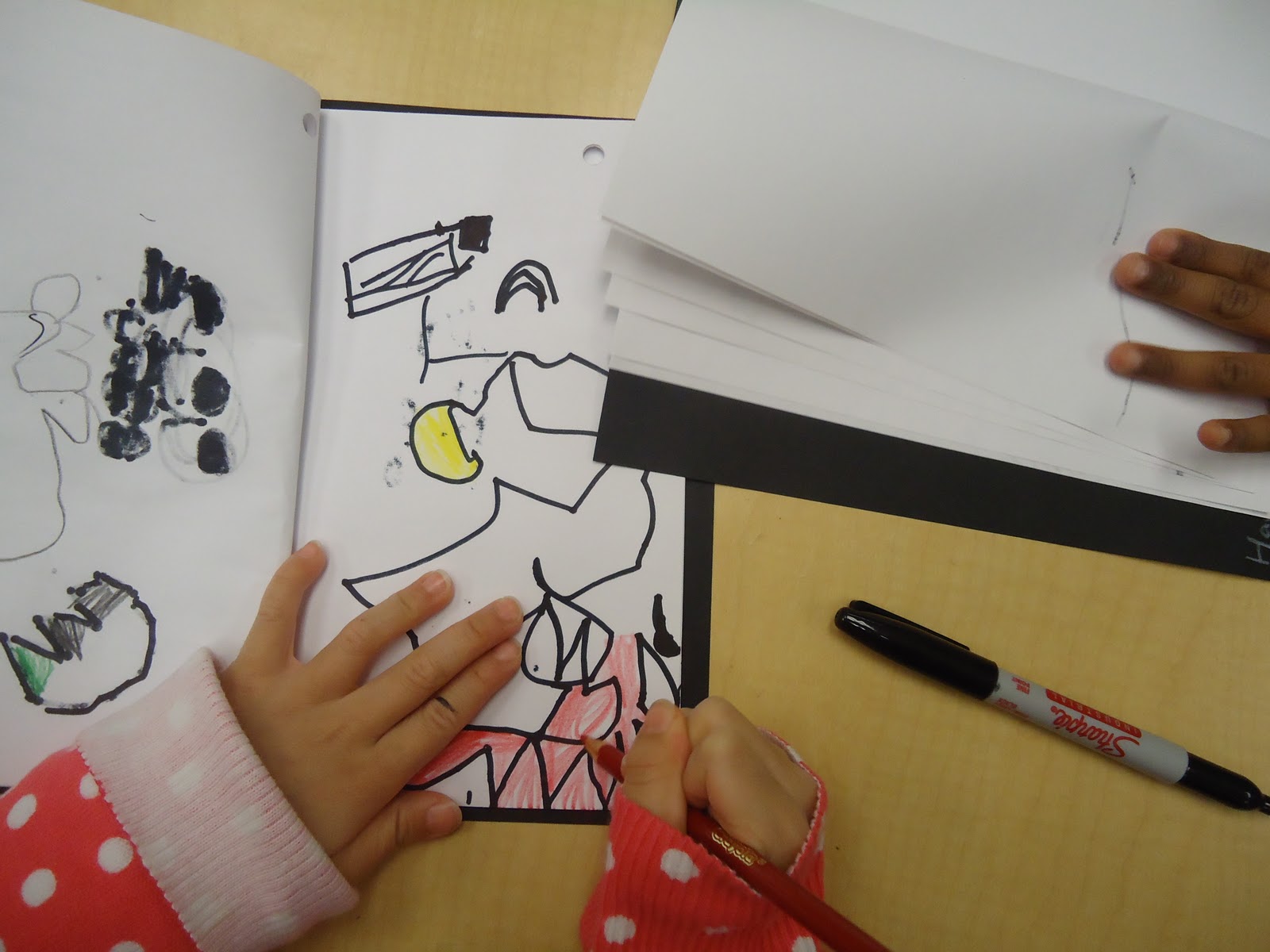
Today we rolled out the sketchbooks. Watching the children today I was struck by their attention, it could be seen in their gaze, their hands, and in the quiet of the room. My mind flashed back to last year and to the meaning created in this year-long routine. It is a ritual that brings paper and writing tools to life in a new way for children. As they are given a book all of their own, to use in any way they wish. I was also reminded of last year because it was perhaps the first moment of the year where I felt like....it wasn't the beginning of the year. That's a wonderful feeling to enjoy.


Interested...
If you are interested in using skectchbooks in your classroom, you can find much inspiration over at bakers and astronauts (which is where I first found the sketch book'n inspiration a few years ago) and many diy sketchbook ideas over at sketchbooks in schools. If you have ideas, please share, I would love to hear how other classrooms use sketchbooks.

Some things to think about before beginning...
Before beginning the routine, I emphasize how special the books are. I do this because I want to encourage children to take their time.  For the most part children really internalize this message and value each page, I do observe carefully and provide a reminder if I see someone breezing through the pages. This usually does the trick.

After some time and practice using sketchbooks, I bring up the idea that sketchbooks are used by many people to express ideas for art and writing. Sketchbooks are very purposeful, they are an outlet for our creative ideas. I don't use a sketchbook unfortunately...but this would be a wonderful time for a teacher to share their own sketchbook! The sketchbooks in schools site has a link to 'artists' books' where you could show children how artists use their sketchbooks. I haven't done this before - but our class will have a SmartBoard in a few weeks so this would be a great way to use it.

For us, this is a daily routine after nap time, it's a calm way to transition to the waking, fully-lit world. Children have the choice of using their sketch books or reading during this time. I find this really works well for our schedule and helps the day flow smoothly.

LinkWithin

Related Posts Plugin for WordPress, Blogger...