Showing posts with label art. Show all posts

Thursday, September 20, 2018

the case of two curious moments

I'm thinking about the gift of being curious.

I struggled with whether to say the gift of curiosity or being curious but really I am talking about the excitement - the joy - during the experience of being curious. Yesterday, two moments occurred that left me filled with joy, wonder, and honestly excited about the rest of our school year.

I'll share both stories through photos:


Act One


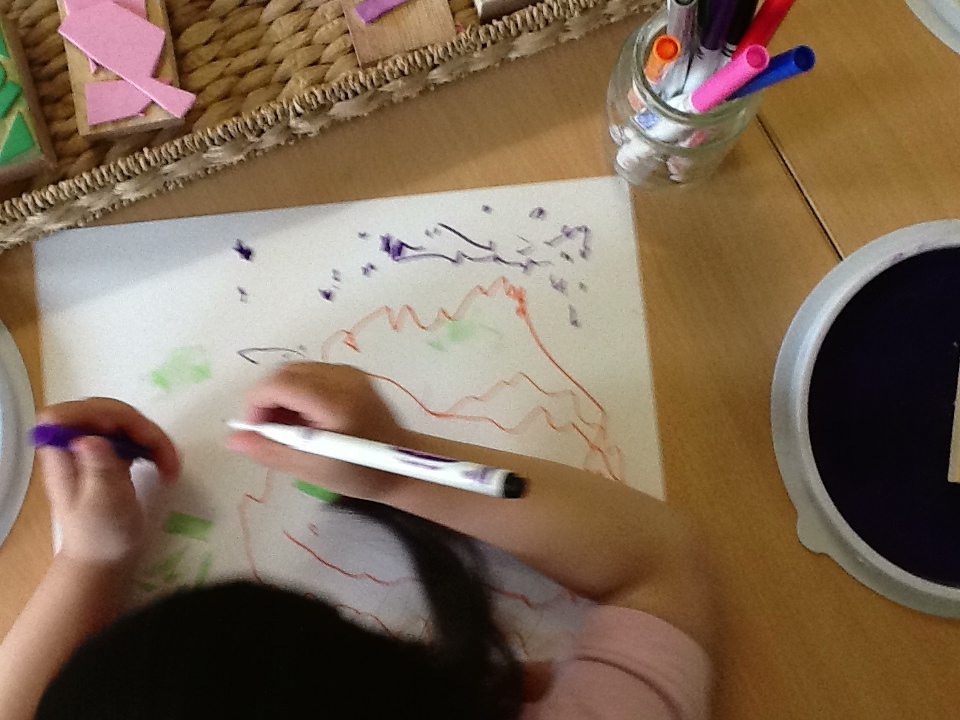
It started with a line. One long line. Then another and, slightly shorter. Then several small lines.

I watched and I was struck by the uniqueness of the drawing. I don't often observe three year old children drawing in this way, with distinctly sized vertical lines. It felt meaningful, especially as he lay the paint pen down and traced his pointer finger along each line.

Yet, I was left with only my sense of sight to make sense of - and wonder about - his approach. This artist speaks Chinese and I do not, so for the moment, I was left with wonderment.


This school year I do not speak the same home language as any of my students. That is a challenge in several important ways, yet in this moment, I was grateful for our language gap. Without the ease of simply listening in or asking and telling I was left to think. Yes, think.

I thought about this particular student's past painting and drawing experiences. I thought about his joy for sensory play. I thought about his age and the fact that, this may not be a representation of anything - and simply a joyful art experience. I thought about how interesting it was that he followed the line with his finger. Why, why, why did he follow the line? It must represent something to him, I thought. I thought about the possibilities, as this idea of line and movement grew into a thought cloud of potential provocations.

The joy of thinking is well, a joy.


Epilogue

I recorded several videos of this student and in one he did engage in private speech. As I shared the videos with the wonderful teaching assistant I work with, who happens to speak Chinese, she shed light on the entire scenario. This boy shared that this was a 'fast train' in his private speech, which also made sense of his finger trailing the lines and the sounds he uttered as well.

Ahhaaaaa!

I am thankful to know the story behind his lines, but I am also thankful for the gift of thinking. It feels good to be curious about our children - it feels good to move through cycles of inquiry and live as a teacher researcher.

I am left thankful for this moment.

Act Two


Three children and a basket of vibrant paint sticks.


The moment was beautiful in and of itself. The three children shared space, allowed lines to merge, and moved around the table like one organism.

Then, more happened.

Not just more, but more completely of the children's own interests and agency.


First one cup, then another, and another...writing tools began to fill the table. They worked as a team, back and forth retrieving cups of markers and pencils, lining them upon the table.

And suddenly, their table space ran out.


Near silently, they agreed to a plan.

Stools were lined up and ever so carefully these cups bearing writing tools filled the tops of stools.


I watched the expressions on their faces. There was such focus, they were doing serious work. I was reminded of my childhood. I grew up in Florida and our little townhouse community had access to a small inlet. There, my best friend and I found sea foam and we concocted a plan to sell slime. Do you remember the gumball machines that sold sticky slime and putty in the 1990s? Well, we set about a new business plan to sell our sea slime and make our fortune. I'm sure our faces showed the same tenacious, serious expressions.

Childhood is filled with these moments and I felt such honor and privilege to observe this moment between two boys - who are new friends - with just a few weeks into this school year. Adults are not needed during these moments, unless called upon. I made my way to the sink and tidied up quietly to give them space, but to allow myself a vantage point to observe and marvel.


Yes, indeed it was a lucky day to be left in awe of childhood, remember my own, and wonder about what we can do tomorrow.


Monday, August 25, 2014

traces in spaces

The beginning.

The beginning of the school year is always exciting.

The rearranging of the room. Finding the balance between cozy and uncluttered. The aim: an inviting blank slate.


Our first day came and went and one word stayed in my mind once the last feet scurried out the door.

"Traces"

Children left traces of their play. Their exploration. Their presence. 


A big part of our classroom culture - a component that we immediately aim to introduce - is the understanding that this room is their room.


The room is just an empty space - hopefully a bit cozy and inviting - but nothing without them. The children are the creators. They bring life, color, and their voice to the room.


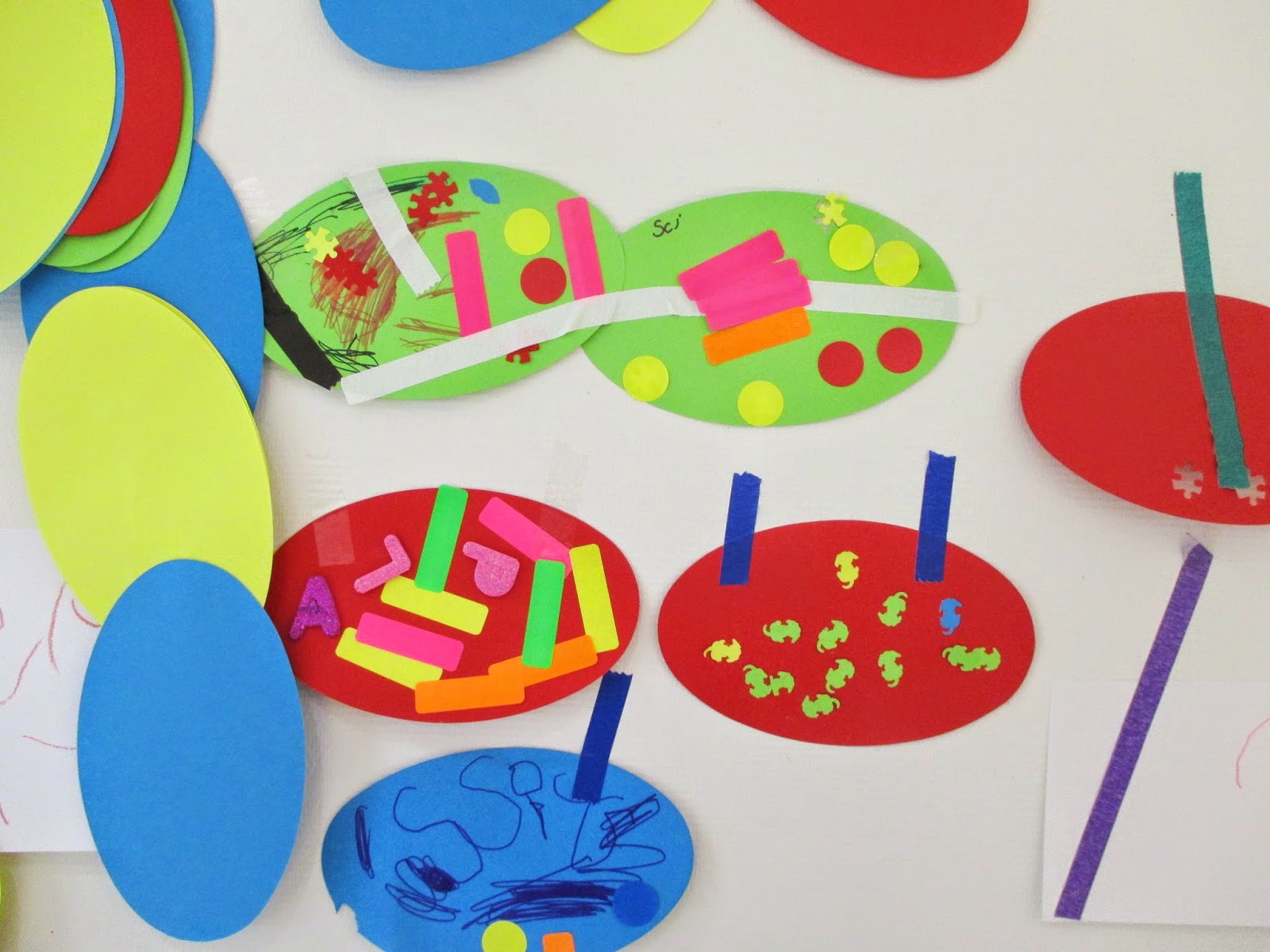
So tape and paper. Paper and tape. They have found their way into our new preschoolers hands and even after the first day as I took a step back and surveyed the room it felt as if a proclamation was made This is our room.


Sunday, September 1, 2013

put a stamp on it

It's been a year and change since the last post. A big move across a sea and navigating a new school last year left me with little to say in this space. I have always used this space as one to share and reflect. Amid change unfortunately reflection can get cropped from the picture...or at the least public forms of reflection. Now in my second year (at a not so new anymore school) I feel there is time once again to reflect here. I also realized how much I missed writing and processing my teaching experiences. 

So.

A new year has just begun. And values are on my mind.

Our values are conveyed in everything we do - every material we place on a table or shelf - every activity we undertake. It's such a responsibility really to be intentional. This year I thought more about art materials than I ever have before. I think this is in part due to how clearly I can see the path ahead of us now. This takes time. Now in my sixth year of early childhood education, I know that using open-ended materials, recycled and found materials to be really important. With this in mind, it means that everything even from the first introductions with glue, scissors, markers, etc can be introduced in a very mindful way.

Can scissors and glue encourage meaningful, open-ended discovery? Can we convey the importance of respecting the tools and materials in a way that resonates with children?  Can an activity be about much more than the individual - can it be about our entire new "family?"

Well. That's where the wondering began. So a collection of stamps is what we made.

Wood scraps, foam sheets, scissors, and glue...all we need for stamp-making.

It was a way to introduce scissor and glue -

in a way that gave a clue about the open-ended art experiences that lay ahead this year.


The next day, markers joined the stamping fun.

And each stamp was shared for all to use...a hint toward the friendships we will surely build this year.

Did they understand all of the subtle meaning? No...but there was intention.

You know when all is said and done. The children did use the materials with pretty remarkable care. And there was not one child who held onto their stamp, each stamp was shared with ease. Part of a collective. Maybe this is because of past experiences - stamps are usually presented as a collection. Perhaps stamps just have that effect - inviting sharing. Or maybe I should just give credit to humanity and our natural instinct to give, share, and be a part of something bigger than ourself...

Monday, December 5, 2011

who doesn't love a robot?

Inspired by a digital story created by second graders at our school, we now have our first pre-k digital storyteller. Who can resist robots and bad guys. Take a look...

Sunday, December 4, 2011

intentional experiences

I mentioned that I would soon write a post to connect the dots - to share what the seemingly random musings about paper and puddles are all about. Well, every experience is meaningful, whether it is connected to something perceived as bigger or not. Every experience is big. However, there is a context that I want to share.

This year two interests have emerged from the children, one being a serious love of water and the other being an equally intense love of puppets. As Ms. Anny and I took these two interests and planned possibilities and provocations, we thought about the skills (potentially) helpful for children. I have been reading Ann Pelo's The Language Art and this quote struck me as such an important reminder.
As children become more comfortable and skillful with these media, they are able to use them to communicate their understandings, emotions, and questions, Their fluency in a range of art "languages," in turn, opens new possibilities for collaboration and dialogue, for taking new perspectives, and for deepening their relationships with each other.
This is our privilege - to support children in knowing the different "languages" available for expressing their ideas, emotions, learning, and questions.
                  
The Language of Clay

As we created anticipatory plans for a puddle and water project we considered how children might represent their learning later in the project. As the playground and manhole covers are central to this - we felt that three-dimensional representation could be important. From this idea we worked backward - determining that observation (and observational drawing) would be an important "language" and would be necessary for any three-dimensional representation to occur. We also felt that experiences with clay would be key.

Do we know if this is where children will take the project? That is a resounding - no - but the language of observational drawing and clay can now be part of their toolbox for communicating and representing. That is our job - to give children the tools. Support them, in learning new skills in using a medium and tools. Then watch what they build.


The Language of Paper

We wanted children to really know the qualities and possibilities of paper and cardboard. These explorations, so intrinsically valuable, will later lead to inviting children to use paper and cardboard to create puppet characters.  We want children to feel confident in their abilities to wield tools and materials - to make meaning with the material.
So, where will it all go? Well, we don't really know. That is the beauty of it all. We will listen, we will observe, we will reflect, and we will value the importance of each experience for what it is - not for what we want it to become.

Tuesday, November 22, 2011

the 100 languages of paper

Somehow time has escaped me in the last two weeks and so much has happened. The Wonderplay conference at 92Y was an inspiration. The keynote speaker, Dr. JoAnne Deak spoke abut brain development. She has a book coming out soon, which I will be purchasing right away, her work is of such importance to parents and educators.  One of the workshops I attended focused on paper construction. The facilitator introduced us to the book Collage and Construction in School by Lois Lord, which is now on my soon-to-buy list. This corresponded with the gift of richly-colored paint chips our class received. Inspired by all things paper, we offered to the children the paint chips, presented in wooden trays and sorted by color. It was interesting to watch children interract with the material.


Though scissors were readily available - most chose to glue the 'chips' as is onto their paper.


From abstract to more concrete, children gave meaning to their representations as seen here with "me, my sister, and my mom."


Through speaking with children about their work, they were often able to add details after verbalizing their thoughts. Here, my friend told me he created "me and robot." At that point his paper only filled by the robot and himself so I asked where he and the robot were. He responded "at the park." With this he reached for green and white paper, adding his park.


When we engaged in deeper conversation with children, their representations grew and they were able to add more details.


The building with all the people and the windows,

Friday, November 11, 2011

on theory and practice

The Hundred Languages of Children has made itself at home in my backback, I take it out for a read most days on my commute to and from work. This section in Eva Tarini and Lynn White's chapter has been earmarked and reread several times over the last week. 

Role of the Adult
Our contact with Reggio educators has caused us to reevaluate the role of the adult in the classroom. We believe that simply providing materials and then managing the group is not sufficient in helping children extend their thinking. Instead, working alongside children for long periods of time helps us all arrive at deeper and richer understandings. We have found that a stronger presence can be very important in helping children focus for longer periods of time, in helping them rise to new challenges, and in helping them express themselves in ways that are more creative, more communicative, and more thoughtful.

As we continue to introduce and expect children to revel in the creative possibilities of open-ended materials it has been a daily reminder - that children need support in imagining the possibilities for such materials.

What I found this week in offering a myriad of colorful glass beads and rocks is that my expectation for children to create representations and stories with the material was met with the reality of their frustration and boredom with the material. I found children 'done' after 10 minutes at the light table, showing me a table covered in a sea of beads . A huge 'oh no' and 'ah ha' moment for me. It could only be through my support (not merely) an introduction of the material that they would be able to maximize its potential. This led to a week of scaffolding, sometimes side by side and other times, a more silent scaffold.

Before this photo was taken (and before I intervened), the light table was a sea of glass beads.


I used paper as a tool to help children organize and design within a space.

Within the spaces, children were able to create representations and give them meaning.


Next week I will make the materials available at the light table again,  to see if the support in using the material helped children in internalizing the creative possibilities. However, I don't think my role is done, I think the potential to unlock imagination and storytelling is present in these beautiful glass rocks and beads but I think I will need to be a part of that discovery process alongside the children. It's a constant reflection on when to watch and when (and how) to intervene. That's really the beauty of being an educator, it is our job to actively think every moment of the day.

What is your view on the subject? How do you support children in using materials or in acquiring skills with a new medium?

Monday, October 10, 2011

in the 'flow'

I have been reading quite a bit about Mihal Csikszentmihalyi's work on 'flow theory.' A person is in a state of 'flow' when they are completely absorbed in the moment, free from distraction and constraints of time. I became interested in this because it is in these states of engagement where creation and innovation takes place. An artist could not create without being completely absorbed in the process of creating, just as a scientist could not innovate, and an author could not write without these moments. We've all experienced such moments, where we are completely taken over by our curiosity and engage it. This is what life is about, being actively engaged in wondering, tinkering, making, and doing.

From an education perspective this directly relates to student engagement, optimal learning environments, and the pursuit of engaging wonder and letting it take children wherever it may. To read more about the theory, read  here. 

The images below are from a day that we introduced the light table as a space for creating art. the calm focus, deliberate mark making, and engagement were present in the facial expressions and movements of each child. How do we, as educators, encourage moments like these? Does our education system value this type of engagement? Is it even valuable?
 
.


Wednesday, October 5, 2011

what would you do with 1000 popsicle sticks?

Okay, now Wikipedia makes the bold statement that stick bombs have been known to children for ages and all I can wonder is "how did I not know?" Thanks to Gizmodo, I saw this inspiring family-built stick bomb today. The pure joy of creating this impermanent experiment is a lesson in physics, creativity, engineering, self-regulation, and dexterity. Not to mention the lesson of non-attachment, the thrill of this is the impermanence.


This seems like a handy tutorial . Time to start collecting Popsicle sticks!

Thursday, September 22, 2011

it's not always black and white

Ms. Annie and I had time, amid all of the beginning of the school year rush to sit down for a few minutes to compare and reflect on our observations. I'm thankful to have a teaching partner who is such a keen observer of children, noticing the subtleties and having such a sense of what is important. In an exploration of white and black paint, Ms. Annie listened (she's a very good listener) and posed questions when needed. One boy remarked, "I've seen this color before...In a black and white picture."


The color gray was never said aloud, we wonder if that is the color he remembers. We wonder where he saw black and white photos. We need to hunt in our homes for black and white photos. We need to ask his parents if they have black and white photos. These are the thoughts, the wonderings, the to-do list that is so often the beginning of projects big and small.

Friday, March 25, 2011

color theories continued

As we have been recording many of the conversations and talk surrounding our explorations of color I have been surprised to hear some of the ideas, feelings and theories surrounding color. Here are some photos and bits of conversation from the week. I know that many Reggio schools study color and I'm definitely curious to hear about the direction teachers and children have taken in studying color, so please share!

This first conversation has an interesting conversation about white/light and black/dark. I'm not sure where we will go with this. But the conversation between K and Mrs. Lee is interesting and I think we will pursue this thread of thought.


K: We need a lot of white
Mrs. Lee: Why do you need so much white?
K: So we can make different colors. White is the most beautiful
Mrs. Lee: Why do you think white is the most beautiful?
K: Because white is the most special because there is a lot of light.
Mrs. Lee: So you think white is a light color and helps us see other colors. That’s interesting.
Mrs. Lee: How about black, can we use black to mix and make different colors?
K: No.
Mrs. Lee: No, why not?
K: Because black is not special.
A: black is special. Because black has so many beautiful mixing colors.


On another day, I began to ask children questions to deepen their thinking about colors but as you can see they were more focused exploring and announcing their discoveries. It's important to know when to push and when to sit back and listen. I think I got the hint pretty quickly to be quiet here.


K: Look I made dark blue. First you need yellow and then red and then blue. You need a lot of blue.
V: I mixed yellow and blue.
C: I made three kinds of different green
Ms. Merril: Can you tell me about the three kinds of green?
C: First I made dark green.
P: I made the dark purple, dark purple, dark.
K: I made light orange and dark orange
C: I made four different kind of orange
V: I made four different kind of orange but Kellie how did you make light green?
K: Umm all of the colors
V: You need all of the colors?
V: Okay, got light green
C: I made light green. I made very dark green.
C: I made a rainbow yogurt. You can see colors underneath because I add so much water
Ms. Merril: I see the colors underneath too
C: And it’s rainbow over here


One morning the conversation focused on how many colors we thought there were in the world. The numbers ranged from 6 to 108. That day children explored mixing colors to create as many color variations as they could. We counted 28 when all was said and done. I'm thinking next week I will bring in the BIG Crayola pack so we can read and see all of the color variations and compare with our findings.


and here is a photo of our new light adorned light center! I couldn't resist posting because I love the lights so much, they make the room feel very cozy. Thank you to a local hardware store who donated quite a bit to us as they were closing down the store.

Monday, March 21, 2011

dots

An inspiring look at color, music, and movement. I happened upon this video while reading the blog urban preschool and am sure this video will make its way into our classroom this week. I wonder how it might inspire children to work with color. The music itself is a bit magical...perhaps I'll have some paper and pastels near the computer for creating art in the moment rather than afterward.


A side note. I visited the Museum of the Moving Image last weekend and this video reminded me of my experience there. I had to pry myself away from the stop motion animation computer stations. There is something pretty amazing about creating moving image art, even though I am not a techy I think it would be pretty exciting to bring this into the classroom on some level. If you have any experience with stop motion animation or incorprating audio visual media in the pre-k classroom please share.

Thursday, March 3, 2011

where we will go nobody can know

The last few days have been really exciting. I anticipated the children's interest in dinosaurs might lead to an interest in reptiles but what has emerged is a real interest in eggs. Their conversations and ideas have been inspiring and we've been luck to have Ms. P with us who has experience with the Reggio philosophy and therefore is a documentation expert. I will try to give some sense of our beginning study here.

Yesterday at morning meeting, I let the children know that we've noticed a great deal of play, art, and talk revolving around dinosaur eggs. I had a balloon with me and I blew it up until we reached a consensus (over the laughter) of what a dinosaur egg may have looked like. Afterward, I prompted them to think of another animal that lays eggs and the idea of a bird came forward. As the conversation continued a few children came up with the idea to build a nest and a tree house on our playground. Six children emerged, being very enthusiastic about this idea of theirs. That small group joined Miss P to draw their plans. Below each plan are their words.


K: My plan is that we can make names of birds in the trees so they know what tree to go to and we put bird food there. These are the nest and these are the houses. Maybe we need paint and we buy wood to make the house. We can find leaves and build a nest. Nest comes from leaves.


Z: This is one leaf. This is a climb. Climb, climb, climb. We can make a house and a bridge.
Ms. P: Why do the birds need a bridge?
Z: Because it’s too tall.


P: That’s a tree house. This is a ladder to climb up the tree. We are going to find bird nest
Ms. P: What can you use to make a nest?
P: Leaves and grass to make a nest. We can go to a zoo and see how a chicken hatches an egg. Then we can take the egg. This is a bird and her egg. She is trying to hatch the egg. She is using her beak to hatch the egg.


C: My plan was there’s two ladders and we can split up in two groups so we can both climb up the ladder and see the bird nest and the house they got eggs.
Ms. M: What materials could we use to build a nest?
C: Some twigs and some yarn, that’s it. Oh and some balloons so he can decorate it!
Ms. M: Have you ever seen a real bird’s nest?
C: Yeah, across the street. I saw it up in that tree, now I don’t.
Ms. M: Where did it go?
C: It went on vacation (referring to the bird)
Ms. M: What happened to the nest? Did the bird take it on vacation?
C: I think the nest broke.

Today, these same children carried forth their plans with such purpose, as you can see below.


Since K showed interest in creating signs for the birds to know which tree to fly to I asked her if she was interested in creating those signs. She was excited to do so and used the fantastic book Bird Songs From Around the World to find images. I gave her a set of post it page tabs and asked her to mark the birds she has seen in our neighborhood or ones that she thinks live in our neighborhood. She paged through the book carefully finding exotic birds that I wish lived in our city.


She used bright colors to write the name of each bird and drew a picture of the bird, so the birds would find the right tree.


Later, Z joined her and they created bird signs together.


Meanwhile, A, P, and C were busy carrying out their plans by constructing a bird house and nest with mostly recycled materials.


Busy hands as you can see.


There was a problem getting the pieces of cardboard to affix to one another using scotch tape, I'm not sure if this was due to the heavy coat of oil pastel on top of the cardboard but it was time to use the big guns...the glue gun! This was the first time we used the glue gun and the boys were very into it.


Tada! P's bird house with a little help from his friends.


and C's bird nest with some contruction help from Ms. P. Each side was cut from cardboard and took a lot of effort to come together as a stable nest.

As I looked around the room today during our working time I was so struck by the juxtaposition of what it looked like as an observer, which was chaos versus what was happening beneath the surface, which was each child completely engaged in the study of eggs in their own (self-directed) way. I watched a documentary last night, The Waldorf Promise and it really made me think about my own education, which was truly unremarkable. I don't feel like I ever had much ownership of it in my early years. It is that unfortunate reality, the reality of the majority, that makes days like this so inspiring and reaffirms that we are moving in the right direction, at least in our class.

LinkWithin

Related Posts Plugin for WordPress, Blogger...